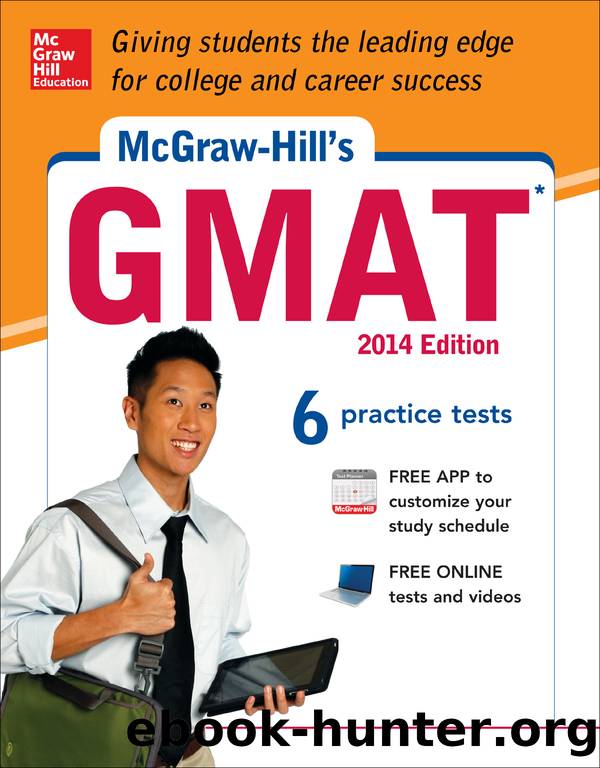
McGraw-Hill's GMAT, 2014 Edition by James Hasik
Author:James Hasik
Language: eng
Format: epub
Publisher: McGraw-Hill Education
Published: 2013-01-15T00:00:00+00:00
Situation. Did you set up the situation or problem quickly and cleanly? Might the listener be bored before you get to the point? Did you use industry-specific geek talk that he couldnât possibly understand? Above all, keep the setup short and strip the story down to the essential point. Eliminate detail.
Task. Did you specify the challenge, job, or project that you faced? Was it obvious, or did you have to work to identify the hidden task that really needed to be taken on? Was it the sort of thing that only a select group of people could handle?
Action. Did you clarify your role in the job or project? Did you specify the action you took? Why it was important? What would have happened had no one acted?
Result. Did you get to a result or describe the outcome? What did you learn from the results? Are your actions still having some effect? Have you repeated this experience since then? As with all things MBA, try to quantify the results.
For each story that you plan to relate, strive to
Make a purposeful transition from situation and task to action and result. There is an art to these stories, and while the concept may seem affected and artificial, skill in relating accomplishments this way will help you, whether you are applying to graduate school, trying to land that job at Booz Allen, or angling to convince a venture capitalist that youâre the one to entrust with her next $10 million. Thus, your stories must be well scripted without seeming scripted. In the end, you just need to know your own career and experience very, very well.
Create a balance between âweâ and âI.â That said, itâs not just about you. The stories you relate about yourself should walk a fine line between extolling your virtues and demonstrating your humility. Talk too much about yourself, and youâll come off as ânot a team player.â Talk too much about the team, and youâll appear to be a straphangerâjust one more warm body loaded in the back of the airplane on the way to the target. See the difference?
Tell the story from the point of view of that functional area. No experience in the software business? No problem, as long as your story plausibly relates to the issue at hand. Remember, the people to whom youâre trying to sell your experience really donât care about your experience. They care about what you can do for them with that experience.
Tell a story theyâd want to hear about. Since they donât care, and theyâre going to need to listen to hundreds of these spiels over merlot and cheese squares, try to be engaging. Your story just might be the one that sticks out and saves the evening.
Download
This site does not store any files on its server. We only index and link to content provided by other sites. Please contact the content providers to delete copyright contents if any and email us, we'll remove relevant links or contents immediately.
The Art of Coaching Workbook by Elena Aguilar(51221)
Trainspotting by Irvine Welsh(21690)
The Secret History by Donna Tartt(19105)
Twilight of the Idols With the Antichrist and Ecce Homo by Friedrich Nietzsche(18642)
All the Missing Girls by Megan Miranda(16052)
Cat's cradle by Kurt Vonnegut(15365)
Ready Player One by Cline Ernest(14681)
Talking to Strangers by Malcolm Gladwell(13376)
Fangirl by Rainbow Rowell(9262)
The remains of the day by Kazuo Ishiguro(9006)
The Compound Effect by Darren Hardy(8978)
Thirteen Reasons Why by Jay Asher(8921)
Tools of Titans by Timothy Ferriss(8403)
Periodization Training for Sports by Tudor Bompa(8278)
Wonder by R. J. Palacio(8118)
The Lover by Duras Marguerite(7908)
A Court of Wings and Ruin by Sarah J. Maas(7858)
Change Your Questions, Change Your Life by Marilee Adams(7788)
The Complete Stick Figure Physics Tutorials by Allen Sarah(7378)
